A film specification that reads “high-temperature nylon, 2 mil” may narrow the field, but it is not a specification in any functional sense. It tells a supplier almost nothing about what the film needs to do, under what conditions, or how its performance will be measured.
When engineers and procurement professionals specify films for composite manufacturing, sterilization packaging, cleanroom environments, or solvent recovery, the distance between a general material description and a functional specification often determines whether the film performs reliably or becomes a problem discovered during production.
The work of specification is translating application demands into measurable criteria a supplier can manufacture against and a receiving organization can verify. That connection between engineering requirements and purchasing decisions is what reduces qualification surprises, supports consistent supply, and gives both functions a defensible basis for comparing materials.
Start With the Application, Not the Material
The specification process should begin with operating conditions, not candidate materials. Before comparing film grades or requesting data sheets, engineers need to define the environment the film will face: temperature range (continuous and peak), chemical exposure, mechanical loads, duration of service, and any regulatory or cleanliness requirements.
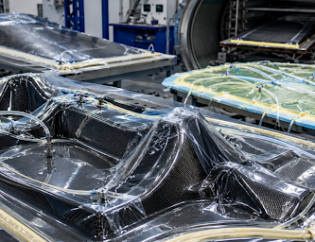
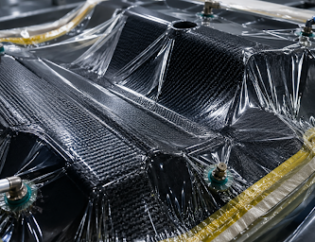
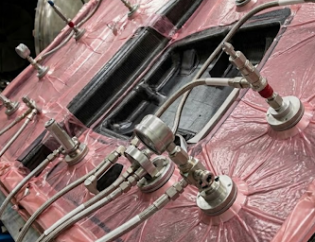
These variables interact, and their interactions are where underspecification creates the most risk. A vacuum bagging film for aerospace composite curing may need to hold seal integrity above 350°F under full vacuum while conforming to complex mold geometries without tearing during layup. Sterilization pouches face a different profile: repeated steam autoclave exposure at 275°F, with seal strength and barrier properties intact cycle after cycle. Cleanroom liners add still another dimension, controlling particulate generation and static discharge in cleanroom-classified environments.
Defining these constraints first establishes the boundaries that every subsequent material decision must satisfy. It also guards against a common and costly error: selecting a film based on a single property, temperature rating being the usual culprit, while overlooking elongation, chemical compatibility, or permeation requirements that matter just as much in the application.
Translate Operating Requirements Into Measurable Film Properties
With application requirements defined, the question becomes which material properties map to those requirements and how to express them so they can be measured, compared, and held to.
Thermal and Mechanical Properties
Service temperature defines the upper boundary for many film applications. But a single maximum rating, taken without context, can mislead. Continuous service temperature, short-duration peak exposure, and dimensional stability under thermal cycling describe different things. A nylon film rated for 400°F may perform well during a four-hour autoclave cure and behave differently during brief contact at that same temperature. The specification needs to reflect which exposure profile actually applies.
Mechanical properties require the same precision. Tensile strength and elongation at break, typically measured per ASTM D882, characterize how a film responds under load. For vacuum bagging, elongation tends to be the more consequential property: a film with 450% elongation conforms to compound mold contours that a stiffer film with equivalent tensile strength simply cannot. Tear and puncture resistance address failure modes that tensile data alone does not predict, particularly where films contact sharp tooling edges or abrasive surfaces.
Barrier and Chemical Properties
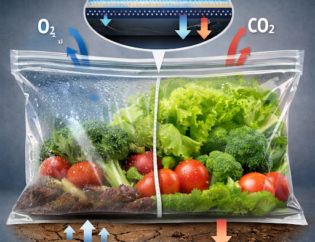
Permeation characteristics matter whenever the film must control gas or moisture transmission. Oxygen transmission rate (OTR), measured under methods such as ASTM D3985, quantifies oxygen passage through the film at defined temperature and humidity. For MAP applications, even modest OTR differences can shift the controlled atmosphere enough to compromise product quality. Moisture vapor transmission rate (MVTR) is equally relevant where humidity control is required.
Chemical compatibility is not a single pass-fail characteristic, though it is frequently treated as one. A film that resists one solvent class may degrade rapidly in another. Specifications should name the exact chemicals, concentrations, and exposure durations involved rather than rely on a general “chemically resistant” claim that gives a supplier very little to work with.
Cleanliness and Regulatory Characteristics
For cleanroom and medical applications, additional properties enter the specification: particulate generation, ionic contamination, non-volatile residue, and electrostatic discharge behavior. One point frequently overlooked: regulatory compliance such as FDA status applies to the specific resin formulation and manufacturing process, not to nylon as a generic material category. A compliant film from one production line does not guarantee compliance from another.
Build a Specification That Can Be Evaluated
Knowing which properties matter is only part of the problem. The harder part is expressing each requirement in terms that allow objective comparison and consistent incoming verification.
That means defining a target value, an acceptable tolerance range, the test method and conditions, and a sampling protocol. Consider the difference: “high elongation” gives a supplier no measurable target. “Elongation at break, 400% minimum, per ASTM D882 at 23°C and 50% relative humidity, machine direction” provides something they can manufacture against, test, and certify.
This is where many specifications quietly fail: test conditions. Nylon films are sensitive to moisture content, and mechanical properties shift meaningfully between low-humidity and conditioned environments. A tensile result at 20% relative humidity may differ substantially from the same test at 50% on identical material. Without defined conditioning and test environment, the resulting data cannot be compared across suppliers or even across test dates within the same facility.
Referencing established standards adds clarity:
- ASTM D882 for tensile properties
- ASTM D3985 for oxygen transmission
- ASTM D1922 for tear resistance
- ASTM D1709 for dart impact resistance
These reduce ambiguity about how a property was measured, though the specification should still define conditions (temperature, humidity, specimen dimensions) where the standard permits variation.
Validate Film Performance Under Representative Conditions
Data sheets describe properties measured under controlled laboratory conditions on specific production samples. What they do not describe is how the film will behave in your process.
Validation closes that gap. It subjects candidate films to the temperatures, pressures, chemical exposures, and durations they will actually face in production. A vacuum bagging film may test well on a flat panel coupon and fail to hold vacuum over a complex contoured tool at elevated temperature and full autoclave pressure. A sterilization pouch may show strong seals at room temperature and lose integrity after repeated cycling. The gap between laboratory data and production reality is often where material failures begin.
Process-representative testing should cover the full range of operating conditions, including worst-case combinations. Validating only at the upper temperature bound may miss problems that emerge at intermediate conditions where material behavior transitions. Single-exposure testing may not reveal cumulative degradation in applications involving repeated thermal cycling.
Pilot-scale trials add another layer of confidence by exposing integration issues that bench testing misses: compatibility with sealant tapes, adhesion to tooling surfaces, behavior during automated handling. Equally important, validation results establish the baseline against which all incoming production material will be judged. Without that baseline, there is no defensible way to distinguish normal lot variation from material that has drifted outside qualified limits.
Evaluate Supplier Capabilities Beyond the Data Sheet
A sound specification and a validated material still depend on the supplier’s ability to deliver consistently over time. The data sheet earned the material a place on the approved list. The supplier’s manufacturing discipline is what keeps it there.
Vertical integration, where the supplier controls the process from resin compounding through extrusion to finished conversion, reduces external variables that introduce batch-to-batch variation and shortens feedback loops when adjustments are needed. For films in mission-critical applications, understanding the degree of vertical integration reveals how much of the supply chain falls under direct quality control.
Certifications such as ISO 9001 confirm that a quality management system exists. The practical questions go further:
- How does the supplier document and communicate formulation or process changes?
- What traceability exists from finished product back to raw material lots?
- What statistical process controls govern critical properties during production?
The answers reveal whether consistency is designed into the process or merely assumed.
Supply continuity carries direct technical implications. A disruption that forces material substitution triggers requalification. In aerospace and medical device manufacturing, where qualification timelines are measured in months, the cost of an interrupted supply chain extends well beyond the purchase order.
When Custom Film Development Makes Sense
Standard products address a wide range of applications. But some operating environments impose requirement combinations that no existing film satisfies, and that gap is usually apparent by this stage of the specification process.
Custom development is not a shortcut, and it should not be treated as one. It adds engineering, prototyping, and qualification work. The decision makes sense when application requirements genuinely cannot be met by adjusting process parameters around a standard film, or when the compromises required to use an existing product introduce risk the application cannot tolerate.
Working with a manufacturer that has formulation capability and application engineering resources can shorten the development cycle. Their understanding of polymer behavior, extrusion parameters, and structure-property relationships defines what is feasible within realistic timelines. Early alignment on target properties, test protocols, and acceptance criteria reduces the risk of iterating on prototypes that solve one problem while creating another.
Bringing Technical Requirements and Supplier Evaluation Together
Film specification is not a document exercise. It is the mechanism that connects what engineering requires to what procurement sources and what quality verifies. When done well, it gives each function a shared, measurable basis for evaluating materials and suppliers.
That mechanism works best when specification, validation, and supplier evaluation function as integrated steps rather than activities handed off sequentially between departments. Materials that meet documented requirements, validated under representative conditions, sourced from a supplier with demonstrated manufacturing control: that is what consistent film performance in the most demanding industrial environments depends on.
M&Q’s engineering team works directly with customers to evaluate operating parameters, review test data, and develop film configurations matched to real-world demands.