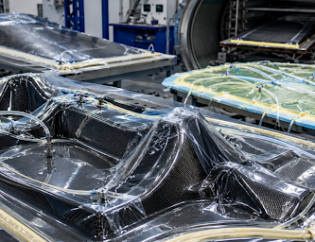
A vacuum bagging film tears during a composite cure cycle because it could not handle contact with carbon fiber reinforcement at 375°F. A sterilization pouch fails its seal integrity test after a third autoclave pass. A solvent recovery liner degrades mid-cycle because no one confirmed chemical compatibility with the specific solvent in use.
These are not hypothetical scenarios. They are the kinds of failures that drive engineers toward nylon film and away from commodity polymers that fall short when thermal, mechanical, and chemical demands converge.
Nylon earns its position because it offers a combination of properties that few single-polymer platforms can match: mechanical strength, thermal stability, gas barrier performance, flexibility, and processability. That said, nylon is not automatically the correct material for every application. The right formulation, structure, and processing conditions still determine whether a specific nylon film meets the requirements of a specific operation.
What Makes Nylon Different From Standard Packaging Films?
Polyolefins such as polyethylene and polypropylene serve the majority of packaging applications effectively. They seal well, resist moisture, and cost less than most engineered polymers. For many operations, that is enough.
The gap becomes apparent when applications impose simultaneous requirements across multiple performance categories. Polyamide films offer significantly higher tensile strength and puncture resistance than polyolefins, maintain mechanical integrity at temperatures where polyethylene softens, and provide meaningfully lower oxygen transmission rates under dry conditions.
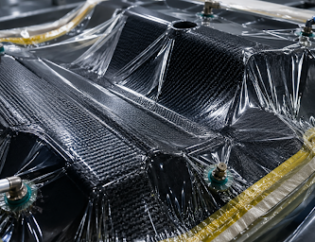
These properties do not operate in isolation. A vacuum bagging film used in composite cure must resist puncture from reinforcement fibers, maintain seal integrity under vacuum at elevated temperature, and conform to complex tool geometries. No single property qualifies nylon for these roles. The combination does.
Mechanical Strength and Puncture Resistance
Film failures during handling, loading, or processing are not merely inconvenient. In composite manufacturing, a punctured vacuum bag can compromise laminate consolidation. In medical packaging, a breach invalidates the sterile barrier.
Nylon films exhibit high tensile strength in both the machine and transverse directions, well above what polyethylene or polypropylene films achieve at comparable thickness. This translates to meaningful resistance against tearing from sharp edges, tooling contact, or irregular product geometries.
Puncture resistance is distinct from tensile strength, and the distinction matters in practice. A film can be strong in tension and still fail when a scalpel tip or a stray carbon fiber creates a point load. Oriented nylon films resist penetration from pointed objects and maintain integrity under localized stress.
Abrasion resistance is often overlooked in film selection, but it directly affects service life in applications involving repeated handling, conveyor contact, or mechanical agitation. Nylon’s surface hardness relative to softer polyolefin films provides a measurable advantage.
Performance at Elevated Temperatures
Temperature capability is one of the primary reasons engineers specify nylon film over commodity alternatives. Polyethylene films soften well below 200°F. Many polypropylene grades reach practical limits near 250°F. Nylon 6 has a melting point near 220°C (428°F), and Nylon 66 melts near 260°C (500°F).
Melting point alone, however, is a poor basis for film selection. This is where many specification efforts go wrong. Service temperature is always lower than the melting point, because mechanical properties degrade as the polymer approaches its melt transition.
The distinction between peak and continuous exposure matters more than most data sheets suggest. A film that withstands brief autoclave cycles at 275°F may not maintain the same mechanical profile during a multi-hour composite cure at the same temperature.
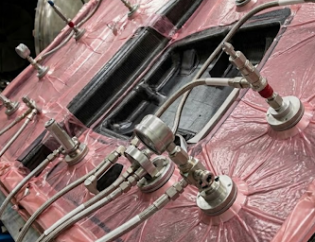
M&Q Packaging manufactures vacuum bagging films rated for service up to 400°F, engineered for autoclave cure cycles in composite and aerospace applications. That rating applies to specific configurations within M&Q’s vacuum bagging film line, not to all nylon films in the portfolio.
Barrier Performance in Demanding Applications
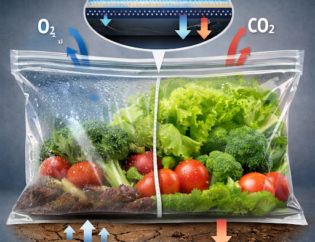
Nylon provides effective oxygen barrier properties, distinguishing it from polyolefins, which are relatively permeable to oxygen and other gases. In applications where oxidation or atmospheric exposure affects product quality, nylon’s barrier contribution is significant.
The critical nuance is that nylon’s barrier behavior is not constant. Oxygen permeability increases as the film absorbs moisture. Performance measured at 0% relative humidity can look substantially different from performance in a humid processing environment.
Film construction strategies can mitigate this effect. In multilayer structures, nylon barrier layers are positioned between moisture-resistant outer layers that limit water ingress. Laminate design, layer ratios, and adhesive tie layers all influence effective barrier performance.
Flexibility and Forming Performance
Many high-performance applications require films that conform to irregular surfaces, stretch into deep-draw cavities, or drape over complex geometries without cracking or thinning excessively.
Nylon films achieve high elongation at break, allowing them to form without the brittle fracture behavior common in stiffer engineering polymers. In vacuum bagging, the film conforms tightly to curved mold surfaces while maintaining sufficient thickness to preserve its mechanical and barrier properties under vacuum.
Deep-draw packaging requires films that distribute material evenly across complex cavity shapes. Where thinning is uneven, weak points develop that compromise both puncture resistance and barrier integrity. Nylon’s ability to elongate uniformly under controlled forming conditions reduces this risk, but “controlled” is the operative word.
Forming characteristics vary with temperature, strain rate, orientation, and formulation. The real question is not whether a nylon film can form, but whether it forms acceptably under the specific conditions of your equipment and process.
Nylon 6 vs. Nylon 6,66 and Custom Formulations
Specifying “nylon film” without identifying the polymer type is insufficient for demanding applications. Nylon 6 and Nylon 66 differ meaningfully in thermal performance, crystallinity, and processing behavior.
Nylon 6, polymerized from caprolactam, offers good toughness, impact resistance, and processability, with a melting point near 220°C. Nylon 66, from hexamethylenediamine and adipic acid, provides higher stiffness, lower moisture absorption, and a melting point near 260°C. Nylon 6,66 copolymers adjust the ratio to modify thermal behavior, crystallization rate, and mechanical properties.
A sterilization film surviving repeated autoclave exposure at 275°C has different thermal requirements than a vacuum bagging film engineered for cure cycles approaching 400°F. A film needing high elongation for deep-draw forming benefits from the flexibility of Nylon 6, while a film prioritizing dimensional stability at temperature favors higher Nylon 66 content.
Custom formulations extend this flexibility through adjustments to blend ratios, additive packages, and processing parameters, allowing films tailored for specific combinations of temperature resistance, elongation, barrier performance, and chemical compatibility.
Where High-Performance Nylon Films Are Used
In composite manufacturing and aerospace, vacuum bagging films must maintain seal integrity under full vacuum at elevated cure temperatures while conforming to complex mold geometries.
Sterilization packaging for medical and dental applications requires films that withstand steam autoclave cycles, resist puncture from sharp instruments, and maintain barrier properties throughout the process. What separates adequate from validated sterilization packaging is system-level qualification: film properties, seal parameters, and cycle parameters must be confirmed together.
Cleanroom and controlled-environment packaging relies on consistent material quality, low particulate generation, and, in some applications, anti-static properties.
Solvent recovery operations subject bags and liners to heat, chemical exposure, and repeated mechanical stress during distillation cycles. Nylon’s chemical resistance and thermal stability are relevant, though compatibility with specific solvents must be confirmed for each application.
How Engineers Should Evaluate Nylon Film
Selecting a nylon film begins with the operating environment, not with a product catalog.
Thermal profile
Identify the maximum continuous temperature, peak temperature, and duration of exposure. Determine whether the film will be under mechanical load at temperature.
Mechanical requirements
Assess whether the primary risks are puncture, tear, abrasion, or tensile failure. Specify whether the film must maintain performance after thermal exposure, not only during it.
Barrier requirements
Identify which gases or contaminants must be controlled, at what transmission rates, and under what humidity and temperature conditions.
Forming and conformability
If the film must thermoform, drape, or stretch, identify the required elongation, the forming temperature, and the acceptable limits of thickness variation.
Chemical compatibility
Identify every substance the film will contact during processing, storage, and end use. Confirm compatibility with the specific formulation under consideration, not with nylon as a generic material class.
Sealing and converting compatibility
Verify that the film’s sealing window aligns with your equipment. Seal temperature, dwell time, pressure, and jaw configuration all influence seal quality. A film that meets every material specification can still fail if sealing parameters fall outside the equipment’s range.
Regulatory and qualification requirements
Determine whether the application requires FDA compliance, cleanroom classification, certifications, or validated sterilization packaging.
Lot-to-lot consistency
In processes where film variability affects product quality, manufacturing consistency becomes a specification requirement.
The sequence matters. Start with the application, then establish the material specification.
When Standard Nylon Specifications Are Not Enough
Many demanding applications require more than standard commercial nylon film grades can provide. The specific combination of thickness, formulation, thermal rating, and dimensional tolerance needed for a particular process may not exist as an off-the-shelf product.
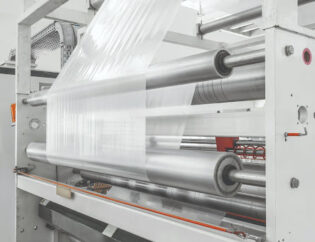
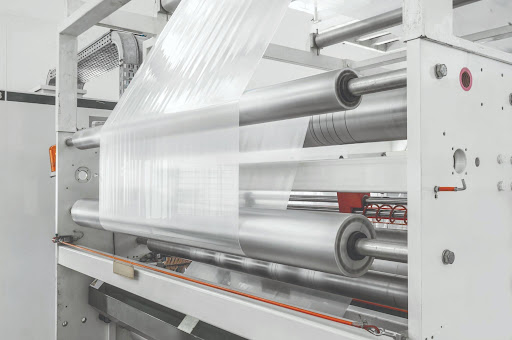
M&Q Packaging has manufactured specialty nylon films in its Schuylkill Haven, Pennsylvania facility for nearly 70 years. Vertically integrated production, from film extrusion to finished product, gives M&Q direct control over formulation, gauge, and quality at every stage.
M&Q produces films in Nylon 6 and Nylon 6,66 formulations, with custom blending capabilities for application-specific requirements. Available thicknesses range from 0.0008″ to 0.006″ (80 gauge to 6 mil) in widths from 2″ to 72″, in tube stock, centerfold, sheet, and bag configurations.
Selecting the right nylon film is an engineering decision that requires understanding the interaction between material properties, process conditions, and performance targets. M&Q’s engineering team works directly with customers to evaluate operating conditions and identify the right film configuration for the application.