Understanding the Vacuum Consolidation Process
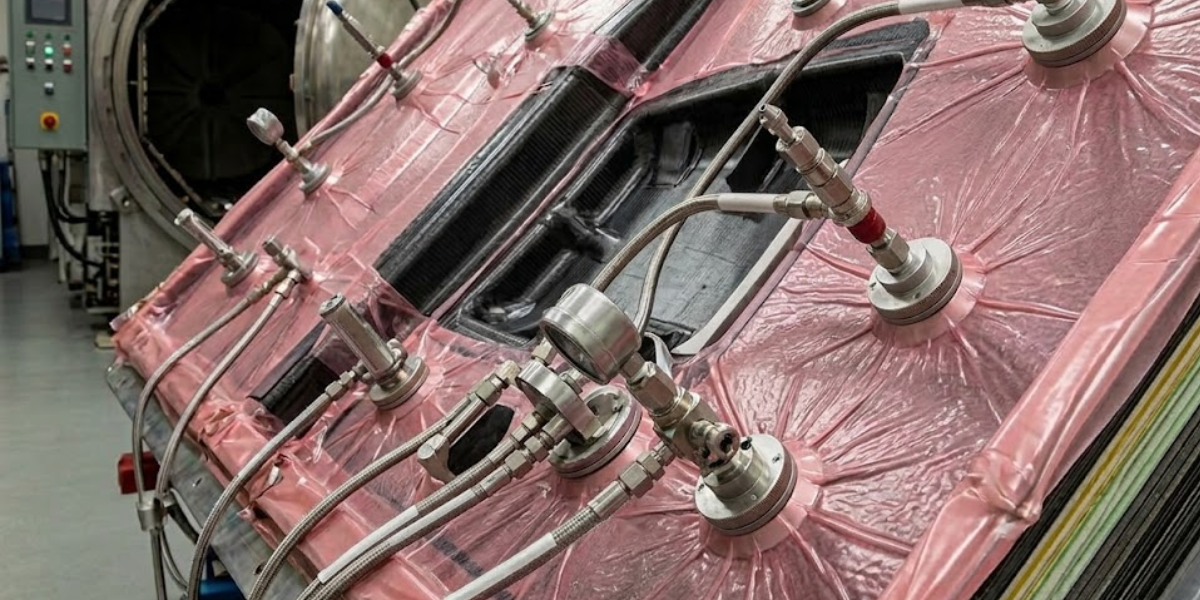
Vacuum bagging is a process control method that uses atmospheric pressure to consolidate composite laminates during cure. By sealing a layup inside an airtight polymer film and evacuating air from the enclosed space, the process applies uniform compaction pressure across the entire part surface.
This serves three primary functions in composite fabrication:
- Consolidation: Atmospheric pressure (up to 14.7 psi at sea level) compacts fiber plies together, improving interlaminar bonding and reducing thickness variation.
- Void reduction: Vacuum extraction removes trapped air, moisture, and volatiles that would otherwise create porosity in the cured laminate.
- Resin distribution: Controlled pressure facilitates even resin flow, preventing dry spots and resin-rich areas that compromise mechanical performance.
Whether processing wet layups, prepregs, or vacuum-infused laminates, the bagging film is the barrier that makes all of this possible. It must maintain vacuum integrity throughout the cure cycle while conforming to complex tool geometries without bridging, tearing, or leaking.
In aerospace, defense, marine, and industrial composite applications, the vacuum bag is not a passive consumable. It is an active component of process control.
What Happens When Film Performance Fails
Film failure during a cure cycle rarely announces itself until the damage is done. A small pinhole, a tear at a corner radius, or a compromised seal can cascade into significant quality and production problems.
Air leaks are the most immediate consequence. When vacuum integrity is lost, consolidation pressure drops. The laminate no longer compacts uniformly, and trapped volatiles cannot escape. The result is increased void content, delamination risk, and inconsistent fiber volume fractions.
Resin flow problems follow. In infusion processes, a leak can introduce air into the resin front, creating dry spots that cannot be corrected after gelation. In prepreg processing, insufficient pressure can leave resin-starved areas or uneven bleed.
Part defects accumulate from these failures: porosity, thickness variation, surface irregularities, and compromised mechanical properties. In aerospace and defense applications, parts with void content above specification limits are typically rejected.
Scrap and rework become unavoidable. A failed vacuum bag on a large or complex part represents not only lost material but also lost labor, lost machine time, and potential schedule delays. For high-value components, a single bag failure can cost thousands of dollars.
Production delays compound when failures occur late in the cure cycle or during autoclave processing, where recovery is not possible. Rescheduling autoclave time, re-laying parts, and repeating quality inspections all extend lead times.
The vacuum bag is one of the lowest-cost materials in a composite layup. But its failure can be among the most expensive.
Key Film Properties That Impact Performance
Selecting a vacuum bagging film requires matching material properties to process demands. Four characteristics are particularly critical.
Temperature Resistance
The film must maintain structural integrity and flexibility throughout the cure cycle, including any elevated temperature dwells or post-cure holds.
Standard composite cure temperatures range from room temperature to 350°F (177°C) for many epoxy systems. Phenolic resins and some aerospace-grade materials require cure temperatures approaching 400°F (204°C) or higher. Autoclave processing adds the stress of sustained heat under pressure.
A film that softens, becomes brittle, or loses barrier properties at temperature will fail. Temperature resistance is a threshold requirement, not a performance gradient.
Elongation and Conformability
Complex mold geometries, tight radii, and deep draws require films that can stretch and conform without bridging or pulling away from the tool surface.
Bridging occurs when a film spans across a corner or recess rather than following the contour. The result is resin pooling, inconsistent pressure, and surface defects at radii. In severe cases, bridging creates stress concentrations that lead to bag rupture.
High-elongation films (some exceed 400%) can conform to intricate shapes with fewer pleats and less manual intervention. This reduces labor time and improves repeatability, particularly on parts with compound curves or male tooling.
Puncture and Tear Resistance
Composite layups are not smooth. Fiber ends, tooling edges, vacuum fittings, and handling during bagging all present puncture risks.
A film that punctures easily introduces leak paths that may not be detected until vacuum is applied or, worse, until the cure cycle is underway. Tear propagation from a small nick can open a larger failure during thermal expansion or pressure application.
Multi-layer extruded films and thicker gauges offer improved puncture resistance but may sacrifice conformability. The selection involves balancing durability against drapeability for the specific application.
Gas Permeability and Seal Integrity
The vacuum bag must function as an effective gas barrier throughout the entire cure cycle. Films with high gas permeability allow air to migrate back into the laminate, negating the benefits of vacuum extraction.
Equally important is seal integrity. The film must bond reliably with sealant tape at the mold perimeter and maintain that seal through temperature cycling, pressure changes, and potential resin contact.
Nylon films are favored in demanding applications precisely because of their low gas permeability combined with chemical resistance to common resin systems.
Matching Film Selection to Process Requirements
Film selection is an engineering decision, not a purchasing convenience. The right film depends on the intersection of several process variables.
Cure cycle profile:
What is the maximum temperature? How long is the hold at temperature? Are there intermediate dwells? Films must be rated above the peak process temperature with margin for thermal overshoot.
Tooling geometry:
Male tools, female tools, and complex contours each present different conformability challenges. Parts with sharp radii or deep draws may require high-elongation films or supplemental intensifiers.
Processing method:
Autoclave curing imposes higher pressures and longer thermal cycles than oven curing or vacuum-bag-only (VBO) processes. Resin infusion requires films compatible with extended vacuum holds and potential resin contact at elevated temperatures.
Resin chemistry:
Epoxies, phenolics, bismaleimides, and cyanate esters each present different chemical environments. Phenolic resins, in particular, release volatiles during cure that require films with strong chemical resistance.
Part criticality:
High-value aerospace structures justify the cost of premium films with enhanced puncture resistance and multi-layer construction. Lower-criticality industrial parts may tolerate standard films with appropriate process controls.
Evaluating these variables against film specifications allows engineers to select materials that match the risk profile of the application.
Where High-Performance Nylon Films Provide Advantages
Nylon (polyamide) vacuum bagging films have become the standard for demanding composite applications because of their combination of properties.
Temperature capability:
Heat-stabilized nylon films maintain performance at continuous service temperatures up to 400°F (204°C), with some formulations rated higher. This covers the cure requirements of most aerospace-grade thermosets.
Low gas permeability:
Nylon provides an effective barrier against air and volatiles, maintaining vacuum integrity throughout extended cure cycles. This is particularly important in autoclave processing where cycles may extend for hours.
Elongation and strength:
Nylon films offer a favorable balance of elongation (often 300% to 500%) with tensile strength and tear resistance. This combination allows conformability to complex geometries without sacrificing durability.
Chemical resistance:
Nylon resists degradation from contact with epoxy, phenolic, and polyester resin systems. This chemical stability prevents film breakdown that could compromise seal integrity or introduce contamination.
Consistent manufacturing:
Because nylon films can be extruded with tight tolerances on thickness, elongation, and barrier properties, batch-to-batch consistency supports repeatable processing.
These properties make nylon films suitable for aerospace structures, defense components, ballistic glass laminates, and other applications where process reliability is non-negotiable.
Engineering Support and Material Qualification Considerations
Introducing a new vacuum bagging film into production is not a simple substitution. Material qualification requires validation that the film performs reliably under actual process conditions.
Technical data review:
Start with manufacturer specifications for temperature rating, elongation, tensile strength, tear resistance, and chemical compatibility. These provide baseline qualification criteria but do not replace process-specific testing.
Process trials:
Run the film through representative cure cycles on representative tooling. Evaluate vacuum hold, seal performance, conformability to radii, and post-cure film condition. Document any anomalies.
Quality verification:
Inspect cured parts for void content, thickness uniformity, surface finish, and mechanical properties. Compare results against parts made with the current qualified film.
Supplier collaboration:
Technical support from the film manufacturer can accelerate qualification. Engineering teams familiar with nylon film behavior across different resin systems and cure profiles can provide guidance on film selection, bagging techniques, and troubleshooting.
Qualification adds time and cost upfront but reduces risk over the production lifecycle. A film that performs marginally in trials will perform marginally in production.
Conclusion: Film Selection Is a Process Reliability Decision
Vacuum bagging films are among the lowest-cost materials in composite manufacturing, but they occupy a critical position in process control. The wrong film, or a film that fails mid-cycle, can turn a successful layup into scrap.
Selecting the right film requires understanding the demands of the cure cycle, the geometry of the tooling, the chemistry of the resin, and the criticality of the part. Temperature resistance, elongation, puncture resistance, and gas permeability are not abstract specifications. They are the properties that determine whether the bag holds vacuum, conforms to the tool, and survives the cure.
For engineers evaluating vacuum bagging film options, the goal is not to find the cheapest film or the most premium film. It is to find the film whose properties match the process requirements with appropriate margin for variation.
Film selection is a process reliability decision. Treat it accordingly.
Request technical data or discuss vacuum bagging film requirements with our engineering team.